“My child wants to go to school. What should I do?”
It is a question that can catch a homeschooling parent completely off guard.
Perhaps your child has always been homeschooled but has become curious about school. They see school buses, sporting events, dances, lockers, and groups of friends portrayed in movies and online. From the outside, school may look exciting.
Or perhaps your child attended school before you began homeschooling. They may miss their old friends, familiar routines, extracurricular activities, or the feeling of belonging to a larger group.
When your homeschool child says they want to go to school, you do not need to panic. And you should definitely not assume that homeschooling has failed.
Instead, listen carefully, discover what is really behind the request, and respond with both compassion and parental wisdom.
Don’t miss the big giveaway towards the bottom of this post!

What to Do When Your Homeschool Child Wants to Go to School
Begin by Finding Out Why Your Child Wants to Go to School
The first question to ask is not, “Should I put my child in school?”
The first question is:
“What does my child believe school will give them that they don’t have now?”
Children rarely ask to attend school because they have carefully compared educational philosophies, curriculum quality, classroom structure, and long-term academic outcomes.
More often, they are looking for something else.
They may want:
- More friends
- More time with a particular friend
- Access to sports or activities
- A larger social circle
- Greater independence
- A more predictable routine
- Time away from their parents
- The experience they have seen in movies or on social media
- An opportunity to see a boy or girl they like
- Relief from a homeschool routine that is not currently working
Do not dismiss these desires. Some of them represent legitimate needs. Your child may truly be lonely, bored, discouraged, or craving more independence.
However, recognizing the need does not mean you must accept your child’s proposed solution.
Your child may correctly identify the problem while choosing the wrong way to solve it.
Listen Without Immediately Debating
When children ask to go to school, parents sometimes become defensive.
They may begin listing everything wrong with public school or reminding the child of all the sacrifices the family has made to homeschool.
That response can cause the child to stop talking before you discover what is really happening.
Begin with questions instead:
- “What interests you about going to school?”
- “What do you think school would be like?”
- “What do you feel you are missing?”
- “Is there something about homeschooling that has been difficult lately?”
- “Are you feeling lonely?”
- “Are you hoping to spend more time with someone in particular?”
Listen calmly. You are gathering information, not surrendering your authority.
A child who feels heard will usually be more willing to hear your answer.
Do Not Confuse Listening With Letting the Child Decide
Parents should listen carefully to their children, but listening does not mean handing children the responsibility for major educational decisions.
Children and teenagers can offer valuable insight into their needs. They should be included in age-appropriate conversations about their education. But they do not yet possess the experience, judgment, or long-term perspective necessary to make every decision for themselves.
Parents routinely make decisions children do not completely understand.
We decide what food enters the home. What media they may consume. Which environments are safe. What responsibilities they must fulfill. Which influences should have regular access to them.
Education is no less important.
You may trust your child’s intentions while still questioning the environment they want to enter.
A parent might say:
“This is not about whether I trust you. I trust that you want to make a good choice. But you would not control the curriculum, the classroom, the other students, or the influences surrounding you. It is my responsibility to consider all of those things.”
Your child’s feelings matter. But the final responsibility still belongs to the parent.
Avoid Treating Homeschooling as a Temporary Experiment
One of the most difficult ways to begin homeschooling is to tell your child:
“We will try homeschooling for a little while, and you can always go back to school if you do not like it.”
Although this may sound flexible and reassuring, it can prevent a child from ever fully adjusting to homeschool life.
Every difficult lesson, lonely afternoon, disagreement, or disappointing day becomes evidence that homeschooling “isn’t working.” Going back to school remains an escape route.
The child may resist forming new routines or friendships because they are still waiting to return to their previous life.
Homeschooling inevitably includes difficult seasons. Parents become tired. Children lose motivation. Curriculum needs to be changed. Social needs shift. None of these problems automatically mean that the family should abandon homeschooling.
When parents have thoughtfully decided to homeschool, children need to know that the family is committed to making it work.
You might say:
“We are a homeschooling family, and we are not planning to enroll you in school. But I want to understand what you are missing so we can work together to improve your experience.”
A firm answer is not the same as an uncaring answer.
In fact, removing the uncertainty can help children stop campaigning for school and begin working with their parents to build a better homeschool life.
Address the Need Beneath the Request to Go to School
Once you understand why your child wants to go to school, address that concern directly.
When Your Homeschool Child Wants More Friends
Friendship is one of the most common reasons homeschool children ask to attend school.
It is reasonable for children to desire companionship. Parents should take loneliness seriously. However, placing a child in a building with hundreds of other children does not guarantee close, healthy friendships.
A child can feel deeply lonely in a crowded school.
Rather than treating school as the only source of socialization, help your child develop relationships more intentionally.
Look for:
- Families who share your values
- Homeschool clubs
- Church activities
- Community classes
- Volunteer opportunities
- Sports or physical activities
- Debate, theater, music, art, or photography groups
- Regular gatherings with one or two compatible families
- Online homeschool classes with supervised social opportunities
Do not merely search for children who happen to be the same age. Look for families whose character, priorities, and direction complement your own.
Children should not be forced to like someone simply because their parents approve of the family. However, parents can create opportunities for healthy friendships by bringing compatible children together.
Quality matters more than quantity.
One loyal friend who encourages your child toward wisdom, faithfulness, and excellence can be far more valuable than a large social circle built around popularity, rebellion, or constant comparison.
When Your Child Misses Activities
Sometimes children are not asking for school itself. They are asking for something associated with school.
They may want to join a sports team, choir, dance, graduation ceremony, more competitions, or a more regular schedule outside the home.
Once you identify the particular activity, look for ways to provide it without abandoning your educational convictions.
Community organizations, homeschool leagues, private instructors, churches, libraries, museums, online academies, and local businesses may offer many of the same opportunities.
You may not be able to recreate every school experience—and you do not need to. The goal is not to copy school at home. The goal is to meet your child’s genuine developmental needs in a healthier and more purposeful way.
When Your Homeschool Child Wants to Go to School Because They Are Bored or Unmotivated
A request to attend school may reveal that your current homeschool routine needs attention.
Ask yourself:
- Is the curriculum too easy or too difficult?
- Does every day feel exactly the same?
- Is my child working alone for long periods?
- Does my child have meaningful goals?
- Are there opportunities to discuss ideas?
- Is my child learning practical, creative, and challenging subjects?
- Does my child know why their education matters?
- Have family tensions made homeschooling unpleasant?
Homeschooling should not simply be public school worksheets completed at the kitchen table.
Children need books, conversations, projects, responsibilities, challenges, mentorship, beauty, movement, creativity, and opportunities to use what they are learning.
Your child may not need school. Your child may need a more engaging education.
When Your Child Wants Greater Independence
Older children sometimes associate school with freedom.
They imagine having their own schedule, spending time away from their parents, making independent decisions, and participating in a world that belongs to them.
The desire for growing independence is natural. It should not be ignored—but independence must be developed gradually and responsibly.
Consider giving an older child:
- Greater control over the order of assignments
- A role in selecting electives
- Independent projects
- Volunteer work
- A part-time job
- Leadership responsibilities
- Opportunities to teach younger children
- Supervised social time
- Responsibility for planning and completing long-term goals
Children do need room to mature. They do not necessarily need to enter a traditional school environment in order to do so.
Explain Why Your Family Homeschools
Children are more likely to value homeschooling when they understand its purpose.
Do not allow homeschool to feel like the strange thing your family does while everyone else participates in normal life.
Give your child a positive vision.
Explain what homeschooling allows your family to do, like study subjects that schools don’t have, read meaningful books that they enjoy, move at a personalized pace, etc.
Your explanation should not consist entirely of fear.
Children need to know what you are protecting them from, but they also need to know what you are preparing them for.
Tell them:
“We are not homeschooling because we are afraid of the world. We are homeschooling because your childhood is valuable, your education matters, and we want to prepare you to enter the world with wisdom, courage, character, and useful abilities.”
Give them something worth choosing.
Help Your Child See the Difference Between an Education and a School Experience
Children often assume that going to school and receiving an education are the same thing.
They are not.
A school is one method of organizing children, teachers, lessons, schedules, and activities. An education is the formation of a person’s knowledge, judgment, character, abilities, habits, and understanding.
A child can attend school every day and receive a poor education. A child can also learn at home, through books, mentors, travel, work, service, classes, conversations, and real-world experiences.
Remind your child that youth is brief.
There are only so many years available to prepare for adulthood. Homeschooling provides the opportunity to use those years intentionally rather than simply following the same standardized path as everyone else.
Your child’s education should help them become capable of doing something valuable—not merely help them complete the same assignments as thousands of other students.
Be Willing to Improve Your Homeschool
A commitment to homeschooling should not become an excuse to ignore your child’s concerns.
Parents can maintain a firm boundary while still making meaningful changes.
After listening to your child, you may decide to:
- Join a club
- Schedule more regular outings
- Invite another family over
- Change curriculum
- Add live classes
- Introduce electives
- Create clearer daily routines
- Reduce unnecessary busywork
- Add more physical activity
- Find a mentor
- Give your teenager more responsibility
- Set academic or personal goals together
You do not have to choose between surrendering your convictions and refusing to change anything.
A wise parent can say:
“School is not the answer we are choosing, but I agree that something needs to change. Let’s make a plan.”
Back to Homeschool Giveaway!
To make improving your homeschool a little easier, I’ve joined a special giveaway by homeschoolers for homeschoolers! Enter to win 4, $200 gift cards towards any homeschool company of your choice! Simply use the giveaway widget below!
Abbreviated Terms & Conditions: The 2026 Back to Homeschool Giveaway is hosted by Hope In The Chaos and runs from August 3-12, 2026. Entrants must be 18 years of age or older and currently homeschooling or planning to homeschool a child in their household during the 2026-2027 homeschool year. By entering, you agree to be added to the email lists of the participating giveaway partners. Four winners will be selected at random using KingSumo and notified by email no later than August 17, 2026. The complete Official Terms & Conditions are available here. By entering the giveaway, you agree to the full terms & conditions.
What to Say When Your Homeschool Child Wants to Attend School
Every family’s wording will be different, but you might say:
“Thank you for telling me how you feel. I want to understand what interests you about school and what you believe you are missing. Your feelings are important to me, and I am willing to make changes where changes are needed.
At the same time, deciding where and how you are educated is one of my responsibilities as your parent. We chose homeschooling for important reasons, and we are committed to it. Going to school is not the solution we will choose.
That does not mean I am ignoring what you need. If you need more friends, activities, independence, or challenge, we will work on those things together. I want your homeschool experience to prepare you for a meaningful life, and I want you to understand why we believe this education is worth protecting.”
This response accomplishes four things:
- It acknowledges the child’s feelings.
- It maintains parental authority.
- It gives a clear answer.
- It promises to address the underlying concern.
You Can Be Firm Without Becoming Fearful
Your child’s curiosity about school does not mean you have lost them.
They may simply be looking at the other side of the fence and imagining that the grass is greener there.
Do not allow fear, guilt, exhaustion, or persistent pressure to make the decision for you.
Listen. Ask questions. Revisit your reasons for homeschooling. Strengthen the areas that need improvement. Help your child form healthy friendships and pursue meaningful opportunities.
Then give your child a clear and hopeful vision:
Homeschooling is not a lesser substitute for school. It is an opportunity to provide a more personal, purposeful, and powerful education—one designed to prepare your child not merely to fit into the world, but to enter it with wisdom, confidence, character, and direction.
Frequently Asked Questions
Should I let my child decide whether to homeschool or attend public school?
Children should have opportunities to express their concerns and participate in age-appropriate educational decisions. However, parents remain responsible for evaluating curriculum, environment, influences, safety, and long-term consequences. Listening to your child does not require giving them the final decision.
Why does my homeschool child suddenly want to go to school?
Common reasons include loneliness, curiosity, missing former friends, a desire for activities, romantic interests, boredom, frustration with the curriculum, or a desire for greater independence. Ask specific questions before assuming the request is primarily academic.
What should I do when my homeschool child feels left out?
Acknowledge the feeling rather than dismissing it. Then create intentional opportunities for friendship, activities, celebrations, clubs, field trips, and shared experiences. Your child may need a stronger homeschool community rather than a complete change in educational setting.
Should I let my child try school for one semester?
Before presenting school as a temporary experiment, consider whether doing so will make it harder for your child to commit to homeschooling. If your family has strong reasons for homeschooling, it may be better to address the specific problem, such as loneliness, boredom, or a lack of structure—without making school the default option.
How can I help my teenager enjoy homeschooling?
Include your teenager in choosing electives, projects, goals, activities, and areas of responsibility. Provide meaningful social opportunities, live discussions, mentorship, work experience, volunteering, and increasing independence. Teenagers need purpose and preparation for adulthood, not merely more assignments.
Build a Homeschool Experience Worth Believing In
Blue Manor Academy helps Christian homeschool families provide a purposeful education through a literature-based curriculum, live classes, clubs, discussions, and subjects designed to prepare children for more than just tests and grades.
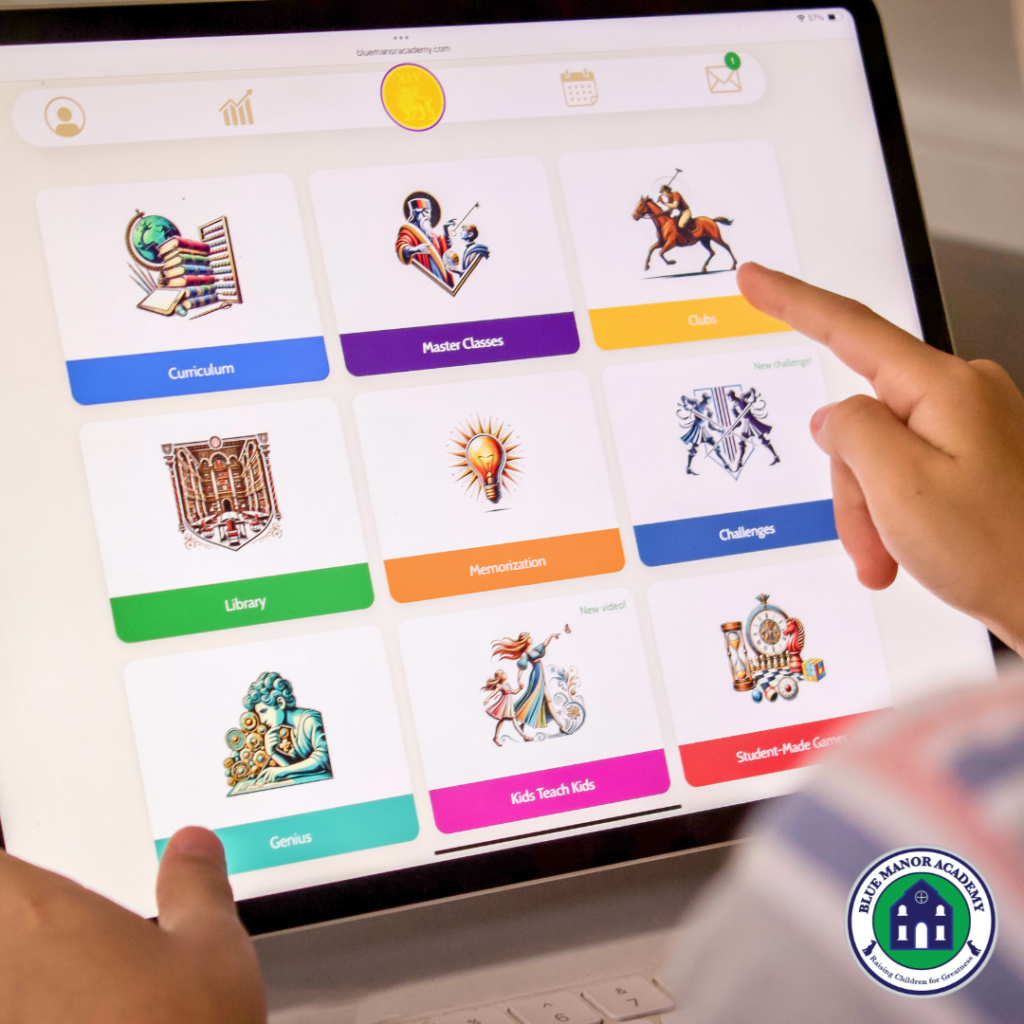
When children understand where their education is leading and have meaningful opportunities to learn, grow, form friendships, and pursue excellence—they are far less likely to believe they are missing out.
Your child does not need a school imitation. They need an education worthy of their future.






Leave a Reply